
 The U.S.,
to all intents and purposes, is at war. For the protection of Israel and indulging
in negotiating with terrorists, citizens of the U.S. have become victims. For
assisting a vulnerable and honorable political friend, the U.S. has itself been
attacked. It is expected that every intelligence gathering method known will
be used to root out the perpetrators, to locate those who colluded with the
terrorists and bring them to justice. It is also expected that there will be
executive action of some sort.
The U.S.,
to all intents and purposes, is at war. For the protection of Israel and indulging
in negotiating with terrorists, citizens of the U.S. have become victims. For
assisting a vulnerable and honorable political friend, the U.S. has itself been
attacked. It is expected that every intelligence gathering method known will
be used to root out the perpetrators, to locate those who colluded with the
terrorists and bring them to justice. It is also expected that there will be
executive action of some sort.
If the authorities in the United States decide to retaliate without thinking it could, assuming the act is attributed to a particular group, precipitate a lengthy war. A knee-jerk response, say, plastering every associated training base and town with high explosives, revoking the visas of all those associated with hostile group and hunting down every agent, large or small, serious or comical, and killing them, could lead to years of warfare and unprecedented economic damage on both sides. But it sure would feel good.
On the other hand, if the military uses its training to check it's response, it can develop a comprehensive plan for dealing with the terrorists without causing a general war. Perhaps a combination of the two responses will best satisfy the desire for immediate revenge and the need for vengeance.
The people of the U.S. will want to see immediate action, some visible proof that their government will not take the assault lying down. Perhaps a battle group sent to the proper region, air strikes on known hostile training bases and economic sanctions would be a good starting salvo.
Then, over the next few months, the intelligence community of the Western World, drawn together by common needs and weaknesses, can sort out exactly which persons and political organizations contributed knowingly or unknowingly to the efforts which resulted in the bombing.
At that point, a coordinated effort between the military and retribution arms of intelligence services could be used to excise individuals, groups and population centers who knowingly contributed to the terrorists efforts.
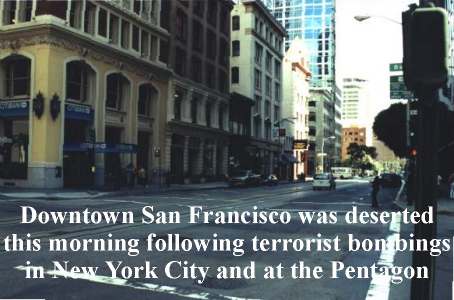
At this early stage, only a few hours after the bombing, the danger is not over. It is entirely possible other cities will be attacked--at least that is the general feeling. Downtown San Francisco is quiet. Many workers have been sent home. The Embarcadero four-building office complex, the Transamerica Pyramid and the Bank of America building are highly visible edifices and have been essentially evacuated. All city, sate and Federal buildings have been closed in San Francisco as well. City Hall is buffered by a cordon extending out two blocks, except for Van Ness Avenue, which is open. A suspicious package was found two blooks from City Hall, but proved to be harmless. See related story.
Information has been gathered from various news soruces and opinions are strictly those of Freelance News Service.