Simply put, Pane e tulipani (Bread and Tulips) is a sweet, provocative, uproarous comedy. It has all the elements of schmaltz: an aging housewife; helpless, clueless husband; fierce anarchist and 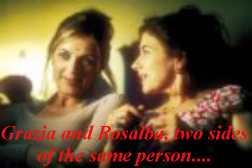 holistic healer and a fat guy, but the movie never descends to the obvious. Instead, Director Silvio Soldino makes the hard to believe, easy to believe; the improbable, palatable.
Is there any reasonable explanation for an apprentice plumber to take to the streets of Venice in search of a housewife and make a success of it? Certainly, if the plumber is a serious aficionado of detective novels, needs a job badly, is reasonably intelligent, the housewife is married to the head of a plumbing supply company and a permanent job is the reward.
The movie is made up of improbable circumstances leading to decisions which the watcher is impelled to agree with. Overtly, Pane is about two drifting souls who bump just as each comes to a crisis point in their lives. It is about Romance in all its glory, banality and seaminess. In the movie, the women are carving out lives they can live honestly somewhere between tradition and reaction. Association with new men gives their lives an intriguing, unpredictable edge. We only get a peeks of the men's lives, but they are indicative glimpses plucking at the romantic tension.
Chivalric, goofy, hapless, or bitter, each of the men is hoping to make the best play of the cards he has been dealt, and each struggles retains his sense of personal dignity in the face of his need for companionship and security. Instead of black and white, as in so many popular movies, the roles are all, male and female, a soft gray, no one is blameless, but no one is to blame, either. This ambiguity draws out the tension of change underway.
The immediate comparison that came to mind is that Pane has some of the autumn wistfulness Kevin Spacey brought to American Beauty, but without the element of violence that surrounded him.
That lack of violence, to me, is a defining characteristic of the Italians, who, from my few visits and other contacts, seem to have retained a huge passion for life thus have no need for the accelerant of violence in theaters. People get mad, but they get past it with some venting and on to a tolerable solution, so that's how characters should act. In Pane, classic Italian rants help define the characters in crisis and Soldino times them to define decisions faced by each character.
IMHO, stellar jobs were done by both Licia Maglietta as Rosalba and Bruno Ganz as Fernando, the lead roles, though all the performances drew me in. One of the beauties for me in going to foreign flicks is that I usually don't know anything about the actors. I have no preconceived picture of what roles the actor takes, how they emote, their physical movements, so it is all fresh, each person seems more real by virtue of their originality. I have heard of Ganz and may have even seen him in a movie or two, but have no recollection of him. He has been an actor since 1960 and has 62 credits listed on the swell movie site, imdb.com (Internet Movie Data Base). Ganz, a German, plays Fernando, an Icelander living in Venice. Fernando's Italian is flawless, mellifluous and almost poetic, but he mostly uses the language to put distance between himself and those around him. Maglietta, an attractive, thoughtful woman facing one of the eternal questions. The rest of the cast was dyno, and I hope I learn more about them, but don't want to give away any plot twists by talking about their roles here.
Director Silvio Soldini started making films in 1982, but I don't have any other information on him. Set mostly in Venice, the movie gives a nice taste of Italy and Italians. The subtitles were really good--the audience was laughing throughout the movie. I did not notice the cinematography (the best sign), clothes were regular clothes, and the Venetian scenery was varied and great without intruding.
There are no taut, silicone-enhanced, hairless bodies and no hot cars. There
is one gun, whose lineage, maintenance and effectiveness are explained in one
of the wonderful, courtly Italian constructions Fernando uses to cover his embarrassment,
which is one of quirks that sets the movie well above the crowd. On a scale
of one to ten, I give this an 8.75 and I'd probably give it a 9 if I understood
Italian. No one gets a ten.
Wm. Cracraft