
The minimum story lined was retained: A young man comes to Paris from the provinces to make his fortune as a musketeer as his father had before him. The musketeers, loyal to the king and queen are opposed by the politically ambitious Cardinal Richelieu. The cardinal conspires to embarrass the king, but the musketeers foil the plot.
As noted, wardrobe, makeup, sets, cinematography, choreography were excellent, with only a
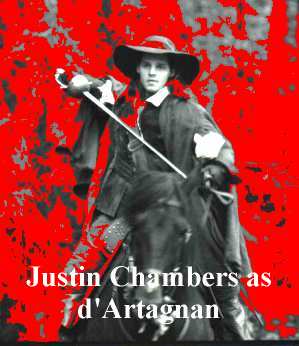 few minor glitches such as an obvious set and the place where the man sliding down the ladder was clearly a stunt double. Overall, though, the plusses far outweigh the minuses. Teeth were blackened, clothes were shapeless and dirty, streets were dark and damp, there were plenty of beggars, and scenery was substantially better than average, IMHO. My consciousness of camera work while watching the flick was very low, which means it was pretty good.
So, there were a number of bright spots, but it is necessary to address the overwhelming dross. Weaknesses include Hollywoodization of the plot, plot holes, crappy fencing, historical impossibilities, hackneyed gags and stunts.
Stupid Hollywood plot changes. Instead of being sent to Paris by his parents as in the original, d’Artagnan parents are killed in front of him when he is a young boy. Febre cut them down in cold blood for not paying church taxes, a highly unlikely occurrence as dead taxpayers are difficult to collect from and even the cardinal's tax collector was not exempt from civil and canonical law.
Thus skepticism is aroused three minutes into the movie. This killing is supposed to set up the basic conflict, but the point is largely ignored throughout the rest of the movie. In the original, d'Artagnan is insulted, then assaulted, by the Man of Meung who is found to have been plotting against the queen. These incidents provide believable reasons for d'Artagnan to pursue Febre/Meung instead of the tacked-on Hollywood death-feud.
Aside from gratuitous plot changes, historical weaknesses that cannot be over looked are multitudinous. One of the absolute worst was the overrunning of a state banquet by riffraff at the cardinal's instigation. When the aghast king questions the cardinal as to the whereabouts of the cardinal's guards(the king's guards having been suppressed by the cardinal) he is told they have grown weak like the king himself.
Are we to expect that the king of France, one of the richest and most important men in all of Europe, had no protection around himself at a state dinner? At a bare minimum there would have been a coterie of courtiers who would have drawn themselves around the royals when danger threatened. For the cardinal to admit his guards had gone bad would be akin to political suicide--if you can't maintain your body guard you can hardly be expected to administer to the entire kingdom.
Kings have always been conscious of the vulnerability of their person and a disciplined, loyal body guard, usually an elite group highly incented to protect the king's person, is one of the most prestigious parts of a king's retinue. Stupid to dismiss this important body with a wave of the Hollywood hand. The cardinal and king were rivals, embodied in their respective guards. The cardinal expected his guards to be better fighters than the king's, yet in this scene he calls his own guard weak and ineffective.
Finally, The little group, king and queen of France, Duke of Buckingham (the most important political figure in England at that time) and a couple of grubby musketeers, escapes via the sewers under the castle. Now, the whole palace wasn't mobbed, just the banquet room, giving rise to the question, why didn't they just leave via the kitchen or some other servant's door? Were they going to be safer strutting down the streets of Paris at midnight? We never found out, because upon surfacing from the sewers, we lose track of their progress. The royals seem to have strolled back to their homes by themselves while the musketeers went into hiding.
Stupid historical weakness number two: the queen of France wandering around the countryside with two guards, an old man and an untried boy. The chances of this happening in 18th century France, when the Queen was watched like a hawk to ensure no dalliances were carried on, are infinitesimal. It only gets more confusing when the group ends up in the home of a chair-bound dowager whose role in the movie is unexplained. One can only assume the producers wanted an aged aunt of theirs to have a role, so one was written in for her.
The combat: Xin Xin Xiong, the stunt choreographer and Febre's stunt double, does a wonderful job of showing the speed and skill necessary in sword fighting, but has fallen into the Hollywood trap of replacing training with camera speed, truncated framing and whirling steel. Sword fighting--fencing--is one of the greatest elements of the Musketeers' story and it was sadly neglected in this rendition.
Xiong, fresh from the triumph of Crouching Tiger, can be forgiven for doing what he does best, choreography, but not for robbing this penultimate story of honor of one of its most valuable dramatic elements: the duel. Xiong managed to innovate a wonderful scene where d'Artagnan, while scaling a tower, duels with an opponent who has let himself down to meet him. The fighters, suspended by ropes, twirl and slash in a slow motion ballet. Overlooking the
 fact that no sane man would lower himself halfway down a 100-foot tower to fence when he could have cut the rope of his adversary without risking his neck, the scene is one of the most original fencing scenes out of hundreds I've seen.
There were one or two other bright spots in the production. First the filth. Everyone was dirty and that is as it should be. Sets seemed authentic, clothing was too close to complain about. Unfortunately, the normal and not excessive effusion of blood accompanying a sword fight was masked by cinematic trickery- another figure interposed between camera and lethal thrust or the old whirling sword and sudden pile of rags. That seemed cheap and contrived to satisfy censors when a sword fight doesn't usually splash a lot of blood to begin with.
One last late-breaking stupid weakness was the scar Febre carried, exposed near the end of the movie to justify Febre's hate for d'Artagnan. It was dealt him by a childish d’Artagnan at the time of his parents death. Never mind that a 4-year old boy couldn't reach the face of a mounted man, even with a meter-long blade, or that Febre's immediate (and quasi-legal) reaction would have been to hack him to pieces for the attack. When Febre's scar was revealed (14 years later) the scar was not particularly disfiguring, hadn't really healed and showed three or four cuts, instead of the single cut that the child d'Artagnan had made. Other makeup was admirable, making it harder to understand why the most important makeup corner in the movie was, if you will, cut.
Alexandre Dumas, who wrote the Three Musketeers in the 19th Century, is supposed to have said," it is acceptable to violate history, as long as one has a child by her." The latest version of Dumas immortal story, Universal's "The Musketeers," violates history in the most egregious manner imaginable and the offspring is but a feeble a member of the family.
Final verdict: stupid Hollywood stuff wrecks another great story. For those
with absolutely no sense of history, no knowledge of the true appeal of the
story of the Three Musketeers and no knowledge of fencing, this will be an amusing
movie, an hour and a half of brainless entertainment utilizing bonehead-simple
plot elements of a 1950's spaghetti western and substituting film editing for
acting.
William Cracraft, Freelance News Service